
Lingoda: Connecting the ecosystem
Role: Head of Product Design and UXR | Company: Lingoda
The brand refresh was only one part of the work. The bigger opportunity was translating an ambitious strategy into a product that could actually be built, aligning Marketing, Product and Engineering around a shared direction while protecting the commercial roadmap during a period of declining B2C acquisition.
The challenge
The organisation wanted to launch the new brand quickly, but Product couldn't simply stop delivering roadmap initiatives. We had to:
Support acquisition during a commercial downturn
Redesign the website
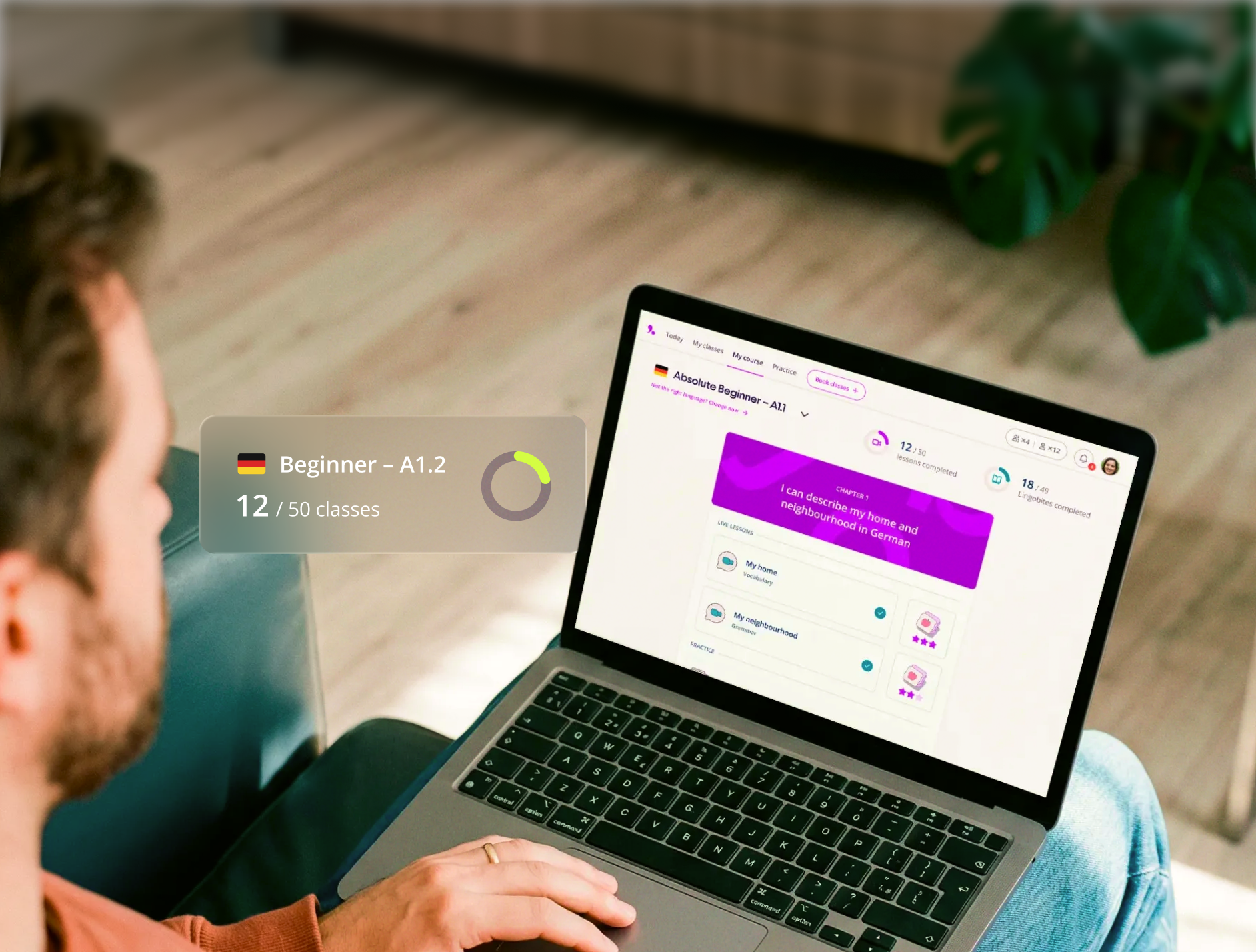
Refresh the product experience
Rebuild the design system
Align Marketing and Product
Continue delivering roadmap commitments
Prepare the foundations for future AI experiences
All within roughly two months. That meant making difficult decisions about what not to build.
Phase 0 · Product vision
The vision was to connect every part of the learning journey. Classroom insights, practice, curriculum and the student platform would no longer exist in isolation. Instead, they would work together to understand each learner's goals, personalise their path, and use AI to support teachers with a smarter, more connected learning experience.
Decision 1
Prioritise business value, not design ambition
One of my earliest decisions was accepting that we couldn't redesign everything.
A complete product redesign would have delayed acquisition work by months and created unnecessary risk.
Instead, I introduced a prioritisation framework based on business impact.
Decision 2
Create a shared language
for change
"Refresh" meant something different to Design, Product and Engineering.
To remove ambiguity, I introduced a simple framework that became the language we used to estimate effort, define scope and assess risk. The framework helped everyone understand complexity before work started, making prioritisation and engineering estimation significantly easier.
| Level | Description | Risk |
|---|---|---|
| Visual refresh | Update colours, typography and spacing through design tokens. | Low |
| Layout update | Reorganise the interface while keeping behaviour unchanged. | Medium |
| Functional redesign | Change both the interface and interaction model. | High |
Decision 3
Build systems,
not screens
Instead, we rebuilt the foundations.
We introduced a new token architecture, restructured the component library, aligned typography, spacing and elevation, and created a scalable system that worked across mobile and web.
Customers saw a refreshed interface.
Engineering inherited a platform that was significantly easier to extend.
Decision 4
Design with Engineering, not for Engineering
My team prioritised the highest-value product surfaces first, while Engineering estimated complexity in parallel.
Throughout the rollout we worked together through pair design sessions, technical reviews and implementation QA, allowing us to validate decisions before development rather than after handoff.
The result was a coordinated release across multiple platforms in approximately two and a half sprints.
From strategy to experience
The refreshed homepage was the first public expression of the new vision. Every decision, from the messaging and visual identity to the navigation and design system, was designed to create a seamless journey from the first interaction through to the learning platform.
Impact
Refreshed experience across the website, student platform, mobile app and classroom
Rebuilt the Product Design System and token architecture for web and mobile
Delivered in approximately 2.5 sprints
One scalable Design System across multiple products
Improved design-to-development workflows through shared tokens and documentation
+3,4%
Visit-to-pricing
56 → 60
Q2 2026 NPS increase
Early product signals
Early results should be treated with caution and cannot be attributed solely to the refresh, but they suggest the redesign achieved its primary objective of supporting the business without disrupting performance.
Product health
Core acquisition funnel remained stable with no negative movement
Revenue trends began recovering during the months following launch
AI-powered learning experiences
Following the refresh, the team launched a new generation of AI-powered learning features, including:
Lingobot, an AI tutor providing conversational practice and personalised grammar explanations
Grammar Trainer, helping students understand and correct mistakes through guided feedback
Lingobites and Flashcards, increasing daily engagement and reinforcing classroom learning
AI Pronunciation Trainer, reaching 50% student adoption
These initiatives contributed to measurable improvements across the learning experience, including:
Month-to-month retention increased from 72% → 82%
Trial-to-order conversion increased from 38% → 61%